
Fantasia and Fugue
Commissioned by Lenka Hlavkova Memorial Fund
Fantasia and Fugue
for Piano and Mridangam
World Premiere
Oct. 19th 2025 (Click here for tickets)
7:30 pm
Tenri Cultural Institute
43a West 13th St. New York, NY 10011
Wang Jie, piano
Anantha R. Krishnan, Mridangam
Presented by Washington Square Contemporary Music Society
Program Note
The seed for this piece was planted about 26 years ago, when I arrived in NY and heard Indian classical music for the first time. I thought: “wow, I know this music. Not sure how, but I do.” Here in the west, composing means leaning into my eyes for notation. There exists a form of music only knowable through the ears, a pure aural heritage, resistant to capture by notation. What I learned from working on “Fantasia and Fugue” is this: exchanging tools is not the same as exchanging cultural perspectives. Notation is a learnable technology. Cultural perspectives? It has required me to create a space between here and there, hoping that it is just as fertile.
What is a Mridangam?
Imagine an ancient percussion instrument capable of evoking the soundscape of a modern symphony orchestra, that’s Mridangam in the hands of a maestro. Torso sized barrel. Layered animal skins strung atight on each end. There is something sacred about producing a musical sound that is hand skin on drum skin. It doesn’t look that way when they play it, but the directness of skin on skin demands that the mridangamist attain tremendous strength while executing extreme dexterity. What if the pianist must bypass the hammer system? Articulated by this kind of touch, the mridangam is said to sound the rhythmic impulses of our universe. That’s a powerful idea. For me, this petite instrument covers roughly four octaves and cries out for a hug when resting upright.
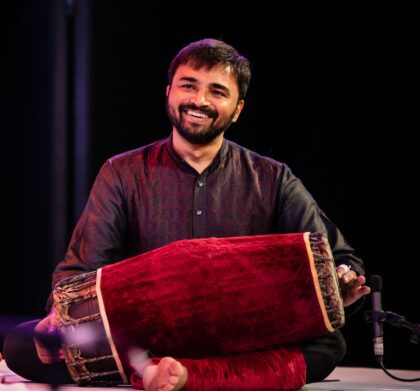
Anantha R. Krishnan on the mridangam
To my ear, the JS Bach of rhythm is Carnatic, a.k.a. south Indian classical music. Mridangam is the principle percussion of this musical lineage. We western classical musicians are mystified by stories of Bach improvising 3-part fugues on a random theme. It’s mystifying because composing a fugue on paper is hard enough, fugue improvisation rises from the strict discipling of counterpoint to first enable, and then to suggest the possibility of beauty upon reason. A Carnatic percussionist does something similar at every concert. Live. I remain mystified by a number of mridangam artists. I think about them often, how they can turn on spontaneity and improvise like jazz musicians. At the same moment, they can be just as disciplined to deliver phrases of mathematical precision. To complicate it more, they play against an ensemble of musician and audiences tapping the pulse like a metronome gone mad (put talam), all this hot mess is just another day to say: math is there, but not the point. Beauty is.
These are my spontaneous thoughts on mridangam this morning, sipping my first cup of coffee. I want to say more about what we might learn from Indian classical musicians performing at this level at this juncture in music history, at this time in our modern world. I would need 5 cups of coffee. Before I jitter and stutter, imagine everything you know how to play is learned aurally, phrase by phrase, body to body, your sheet music library filed as the cells of your bones. At the end of the day, I can teach anybody to read music. I can’t always locate the music in notation. It worries me.
See also:
Contact Wang Jie to inquire about the score
15 Oct 2025